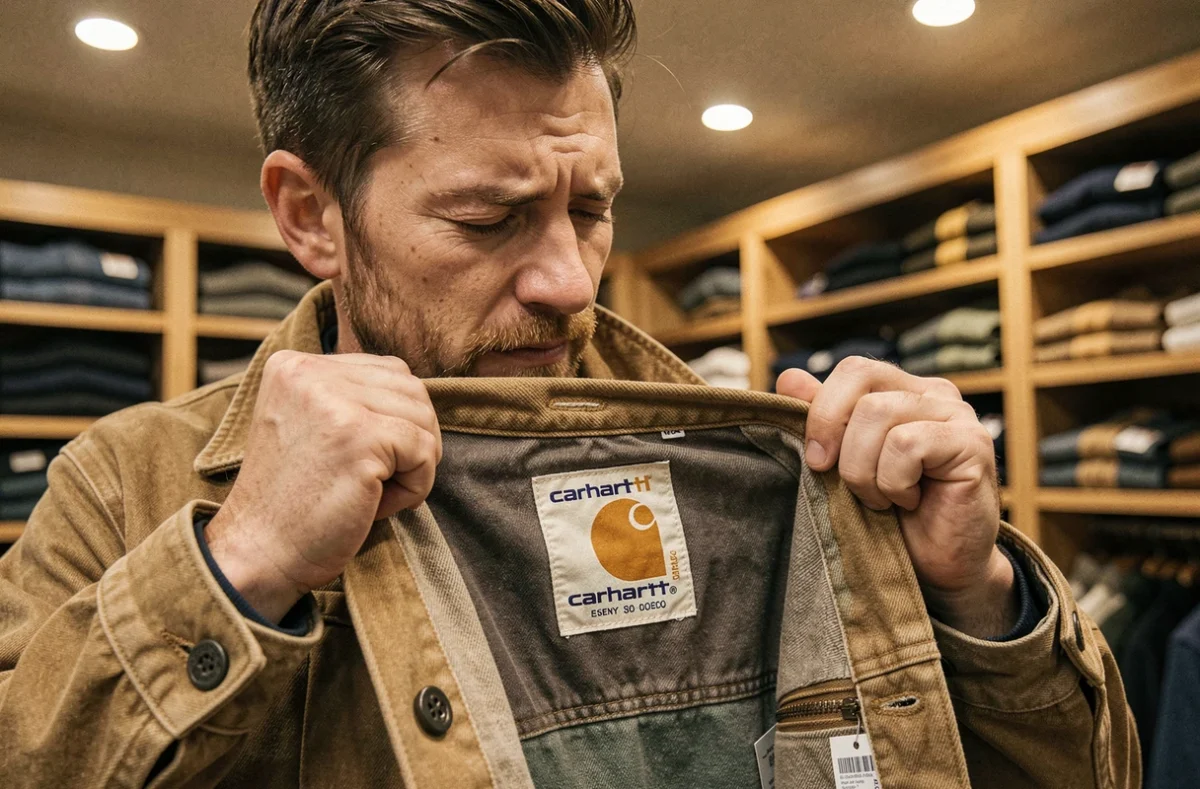
A fake Carhartt is rarely identified by a single detail. Counterfeiting has become more refined, and crude copies now coexist with replicas whose patch seems correct at first glance. We observe that the most reliable errors to detect lie in the consistency between labels, product reference, and finishes, much more than in a poorly centered logo.
Style number and care label: the cross-check that fakes miss
The most reliable method to authenticate a Carhartt garment relies on the cross-check between the style number printed on the inner label and the actual characteristics of the piece. Each Carhartt model has an alphanumeric reference that corresponds to a specific cut, textile composition, and range of colors.
On an authentic piece, the care label mentions the style number, composition, country of manufacture, and washing instructions in a consistent format. Counterfeits often reproduce a real style number but associate it with a fabric or cut that does not match. Comparing the reference to the product sheets on the official Carhartt website remains the most discriminating action.
We regularly find these Carhartt tips on Saint-Malo applied to vintage pieces, where the reference also helps date the garment and verify the consistency of all markings.
A point overlooked by most guides: the country of manufacture is not enough to decide. Recent and authentic Carhartt items are made in Pakistan or Mexico. Dismissing a piece solely because it is not “Made in USA” is a common mistake. The verification focuses on the consistency between country, reference, and composition, not just the country alone.
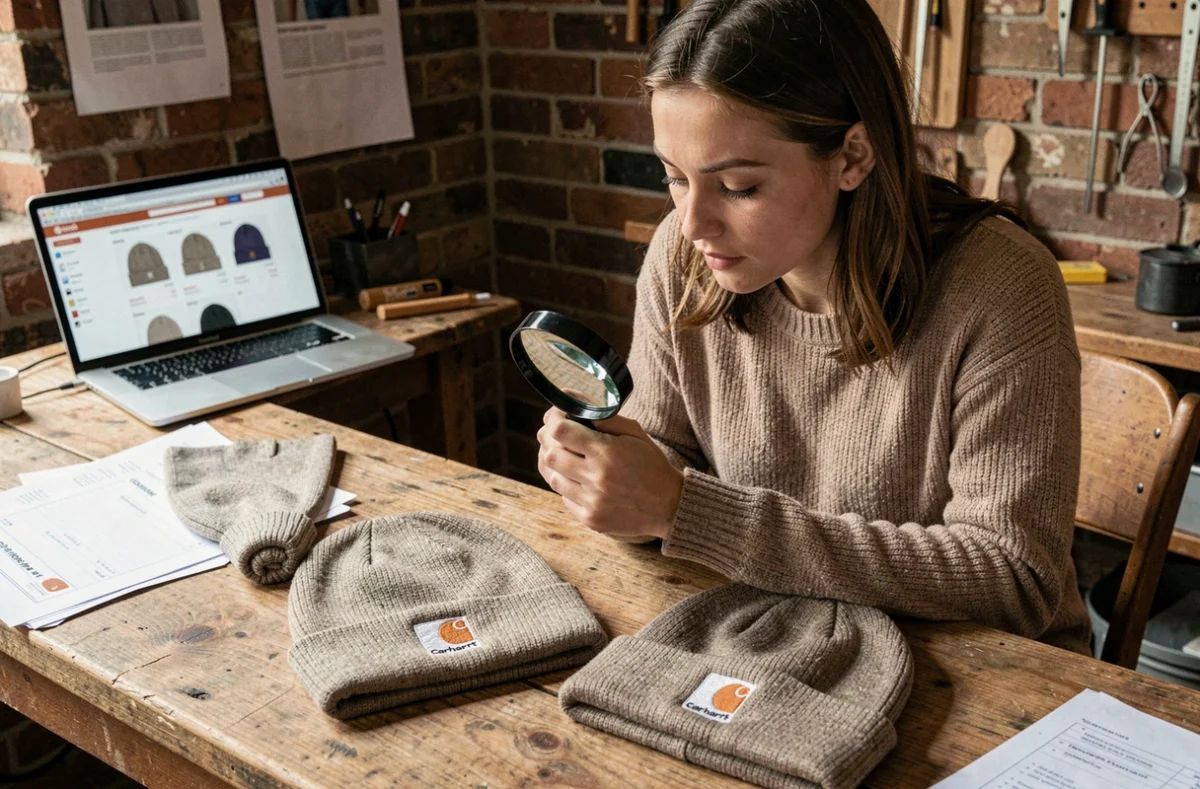
Carhartt WIP and Carhartt workwear: identifying the line before shouting fake
A more fitted cut, a square logo instead of the arc logo, a different composition label: these elements do not indicate a counterfeit. They indicate a Carhartt WIP (Work In Progress) piece, the European line developed under license for urban use.
Carhartt WIP and Carhartt workwear are two distinct authentic lines. Confusing them leads to rejecting legitimate pieces or, conversely, validating a fake because one attributes its anomalies to “the other line.”
The concrete differences to remember:
- The WIP logo is a square with a stylized “C,” while the US workwear logo features the arc-shaped cartouche with the full name “Carhartt.”
- WIP sizes follow European standards (S, M, L), while the US line often uses a W x L format in inches for pants.
- WIP labels generally mention a European distributor and specific references, distinct from the US catalog.
The best practice is to identify the line at first glance on the label, then compare it with the corresponding catalog. A WIP Detroit Jacket has a shorter cut and a different positioning than its US workwear counterpart, without one being more “real” than the other.
Stitching and duck canvas: finishes that counterfeits struggle to reproduce
Carhartt workwear is distinguished by double or triple stitching at stress points (armholes, pockets, inseam). On an authentic piece, the topstitching is even, with thick thread and consistent tension. Fakes often feature single stitching in areas that should be reinforced, or thin threads that do not meet the specifications of a work garment.
Carhartt duck canvas has a recognizable touch and weight. The fabric is dense, stiff on a new piece, and develops a characteristic patina with use. Counterfeits frequently use lighter cotton or a synthetic blend that reveals itself through touch. The color “Carhartt Brown,” this deep ochre specific to the brand, remains difficult to reproduce accurately.
Buttons and closures: engraved markings, never printed
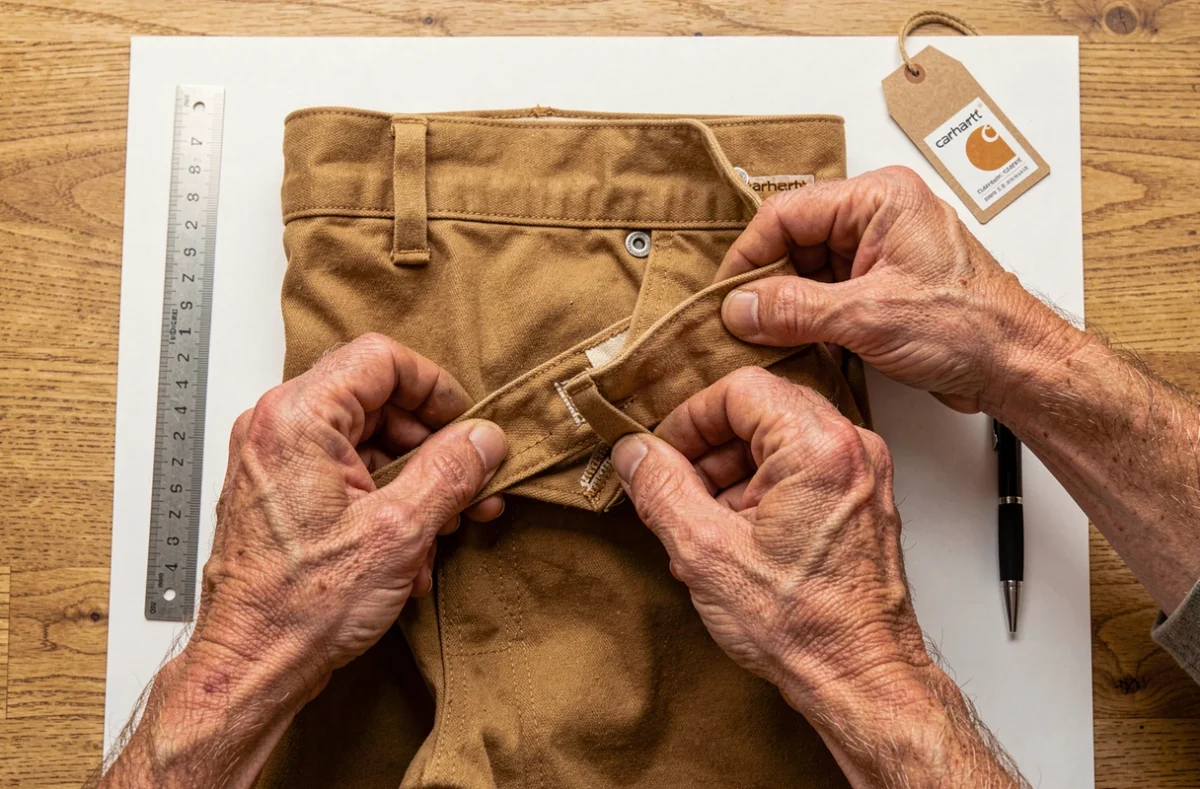
On workwear jackets and pants, metal buttons bear the engraving “Carhartt” in relief. A button that is simply printed or smooth is an immediate warning signal. A zipper without a brand or with a light pull tab deserves a thorough examination of the rest of the piece.
Holographic tape and packaging: what proves and what proves nothing
Some recent Carhartt labels include a holographic tape on the care label. Its presence is a positive indicator, but its absence does not automatically mean a counterfeit. This tape depends on the manufacturing period and model. Vintage pieces or certain references do not have it.
We recommend never relying on packaging elements (stickers, bags, potential QR codes) as proof of authenticity. These elements are the easiest to reproduce and are not a reliable criterion. Verification should always return to the markings integrated into the garment itself.
Signals that should raise immediate alerts
- A spelling mistake on the brand name (“Carhart,” “Carharrt,” “Carthart”) printed on a patch, button, or label
- A “C” logo embroidered with proportions or line thickness that differ significantly from official visuals
- A price significantly lower than the second-hand market for a sought-after model (a vintage Detroit Jacket for a few euros, for example)
- The complete absence of a style number or a reference number that does not correspond to any listed model
The Carhartt counterfeit market focuses on the most sought-after vintage pieces: Detroit Jacket, chore coat, double knee. Basics (t-shirts, beanies) are less targeted by counterfeiters, as the effort/margin ratio is less interesting. This distribution usefully guides the level of vigilance to apply according to the piece being examined.