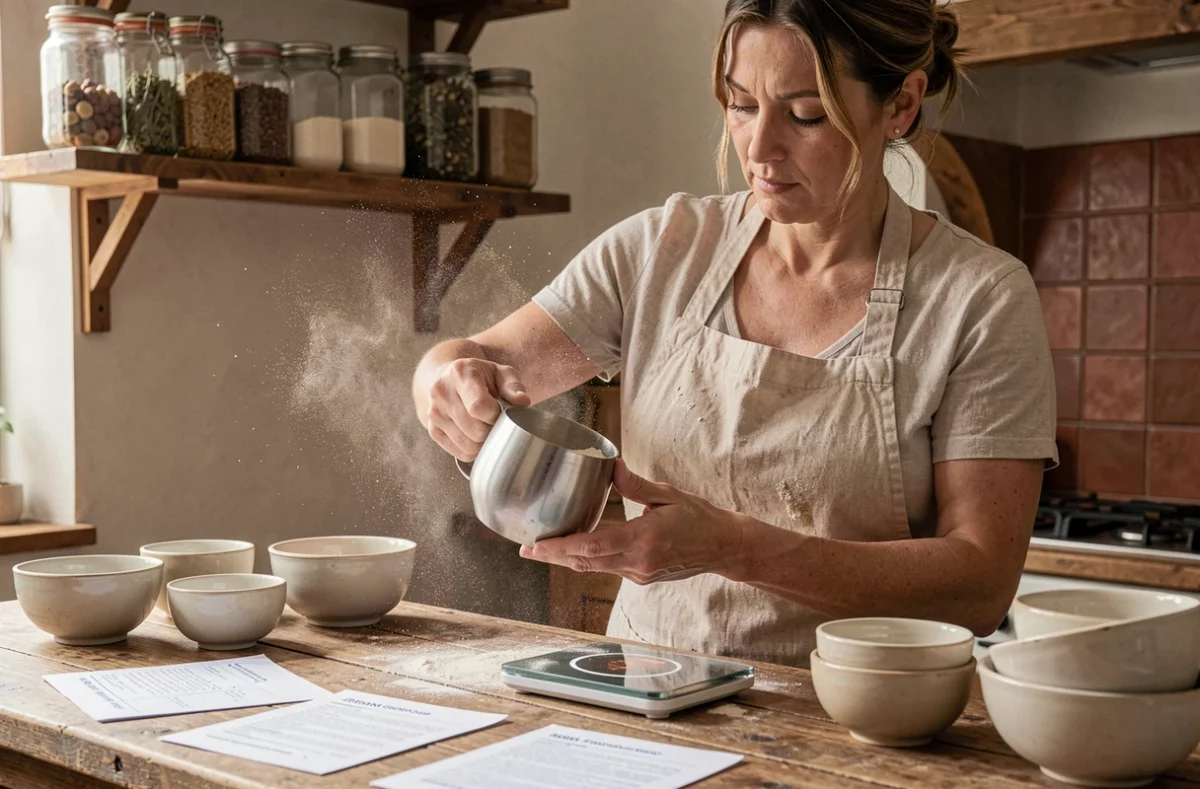
The conversion of measurements in cooking relies on a variable that most equivalence tables overlook: the actual density of the ingredient at the time of sampling. A cup of sifted flour, a cup of spoon-aerated flour, and a cup of packed flour at the bottom of the container do not produce the same mass. Working with fixed equivalences without considering this reality introduces discrepancies that accumulate over an entire recipe.
Density and Packing: Why a Cup Never Weighs the Same
The volumetric measurement system (cups, spoons) was designed for domestic contexts where speed takes precedence over reproducibility. In volume, a dry ingredient like wheat flour, cocoa, or cornstarch varies significantly depending on how the container is filled.
We recommend distinguishing three categories of sensitivity to packing:
- Fine powders (flour, cocoa, powdered sugar): the variability from one cup to another is the highest. Depending on whether you dip the cup into the bag or fill it with a spoon, the mass difference can reach several tens of grams for the same volume.
- Medium granules (granulated sugar, rice, semolina): the density is more stable, and the packing is more limited. Volumetric conversions remain approximate, but the error is within a narrower range.
- Liquid or semi-liquid ingredients (water, milk, oil, honey): the volumetric measurement is reliable, provided you use a graduated container suitable for liquids and read at the meniscus.
If you regularly follow Anglo-Saxon recipes, quickly finding Madame Gertrude’s cooking tips allows you to convert cups to grams without memorizing each equivalence by ingredient.
Cup to Gram Conversion: Table by Ingredient Rather than by Volume
A useful conversion table does not provide a single line “1 cup = X grams.” It specifies the ingredient because density changes everything. Here are the benchmarks we use, based on the standard American system (1 cup = 236.59 ml).
| Ingredient | 1 cup (approx.) | ½ cup (approx.) |
|---|---|---|
| Wheat flour (spoon method) | ~125 g | ~60 g |
| Granulated sugar | ~200 g | ~100 g |
| Butter | ~227 g | ~113 g |
| Water / milk | ~237 ml | ~118 ml |
| Cocoa powder | ~85 g | ~43 g |
These values are indicative. The only reliable conversion is through direct weighing, especially for fine powders.
Tablespoons and Teaspoons: The Micro-Conversions
In the American system, a tablespoon corresponds to 14.79 ml and a teaspoon to 4.93 ml. The metric system rounds to 15 ml and 5 ml respectively, which does not pose a problem in everyday cooking.
The difference becomes significant when you multiply the doses. In a recipe calling for eight tablespoons of cocoa, the cumulative difference between the American standard and the metric rounding represents almost an additional teaspoon. For baking, we observe that weighing remains the safest method once you exceed four tablespoons of the same ingredient.
Successive Tare Weighing: The Method That Replaces Cups
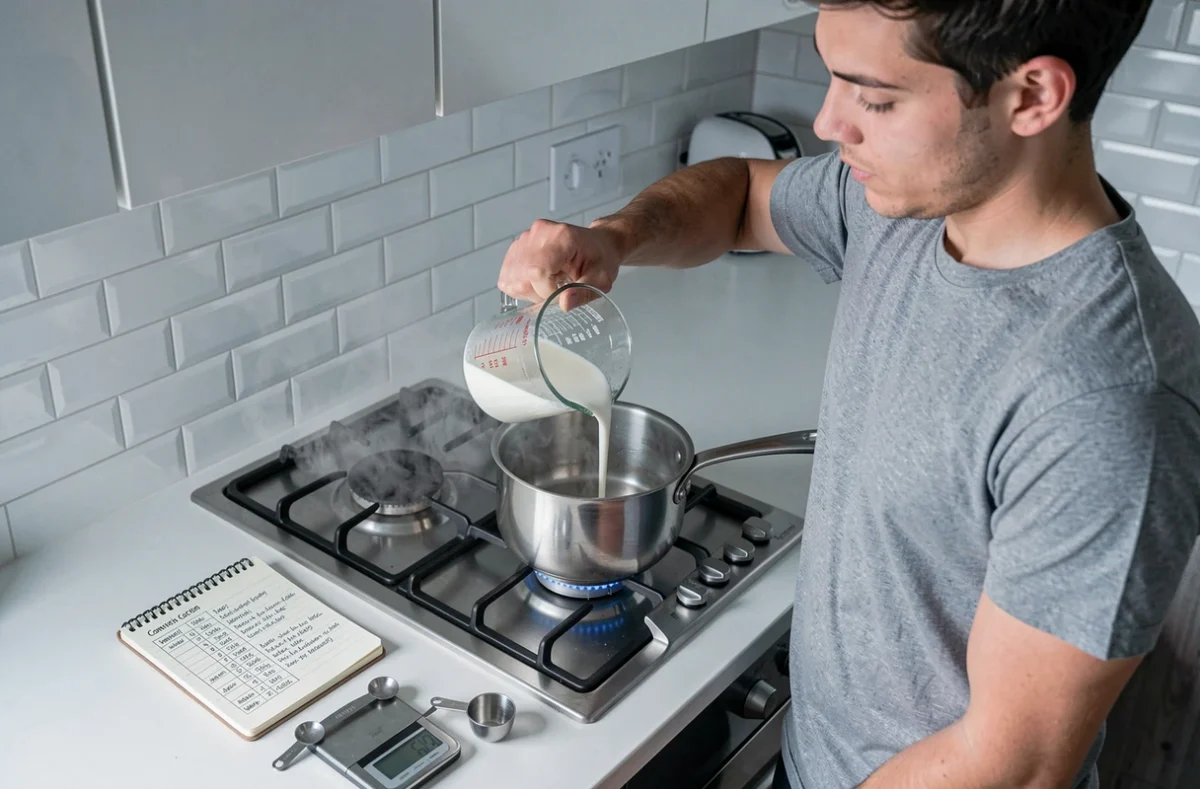
Placing the bowl on the scale and taring between each addition eliminates both volumetric inaccuracy and dirty dishes. The technique is simple: place your working container on a precision scale, reset to zero, pour the first ingredient to the desired weight, tare again, and then add the next one.
This approach is particularly relevant for scaling recipes. Multiplying or dividing quantities in grams amounts to direct arithmetic calculation. Multiplying “¾ cup” or “2 level tablespoons” generates cumbersome fractions and cascading rounding.
When Temperature Comes into Play
For most preparations, ambient temperature does not noticeably affect the mass-volume conversion. The limit appears in baking and sourdough work, where hydration must be reproducible from one batch to another. Weighing the water and noting its temperature ensures a consistency that measuring in cups cannot provide.
Metric System and Anglo-Saxon System: The Concrete Traps to Know
The most common confusion does not come from the calculation but from identifying the system used by the recipe. Two traps consistently arise.
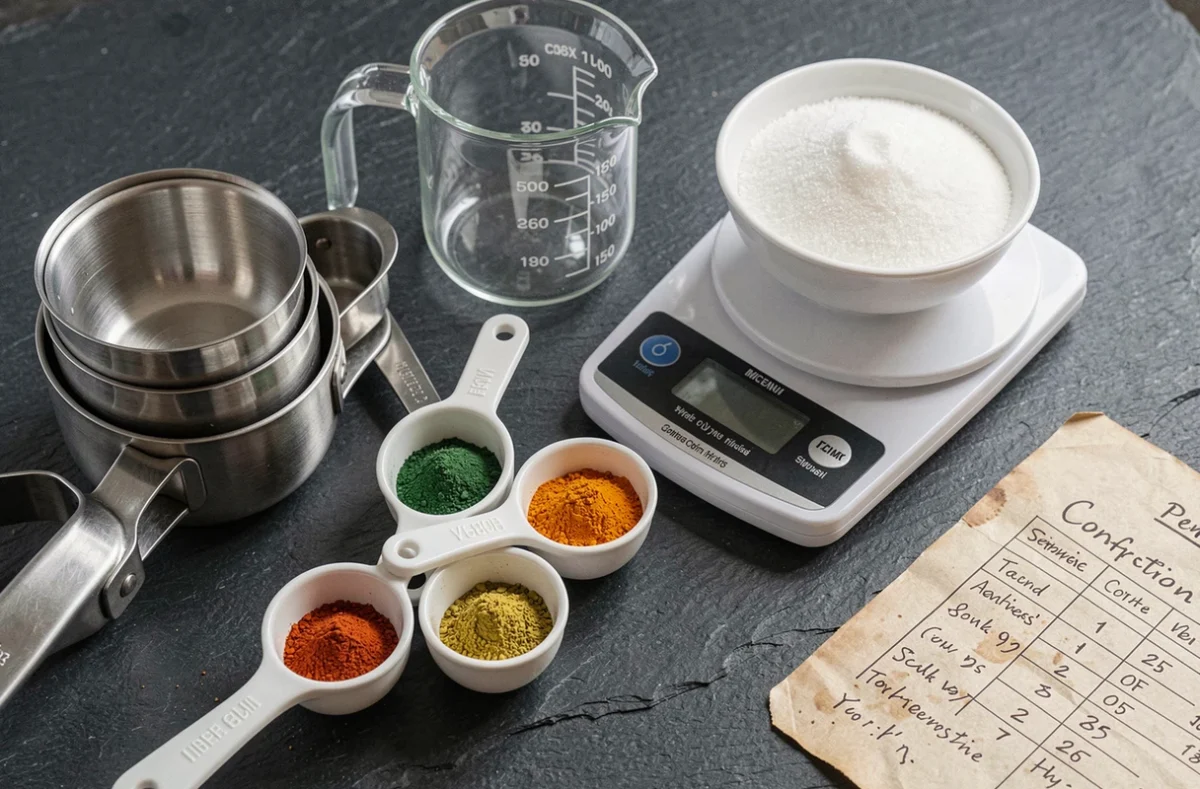
The first concerns the cup itself. The American cup (236.59 ml) differs from the British imperial cup, which is larger. When a recipe in English states “1 cup,” check the source’s origin before converting.
The second trap concerns ounces. The fluid ounce measures volume, while the dry ounce measures mass. The abbreviations “oz” and “fl oz” are often confused in online recipes. One dry ounce is approximately 28 grams, while one American liquid ounce is about 29.6 ml.
Thermostats and Oven Temperatures
French recipes sometimes use the thermostat (Th.), where each level corresponds to 30 °C. Thermostat 6 means 180 °C. Anglo-Saxon recipes most often indicate degrees Fahrenheit. The conversion formula is (°F – 32) × 5/9 = °C, but in practice, remembering three benchmarks is sufficient: 350 °F = 180 °C, 375 °F = 190 °C, 400 °F = 200 °C.
The accuracy of measurement conversions in cooking depends less on the formula used than on the nature of the ingredient and the method of sampling. For powders and solids, the scale remains the most reliable tool. For liquids, the graduated measuring cup does the job. Conversion tables by ingredient are useful as quick references, provided they are never treated as absolute values.