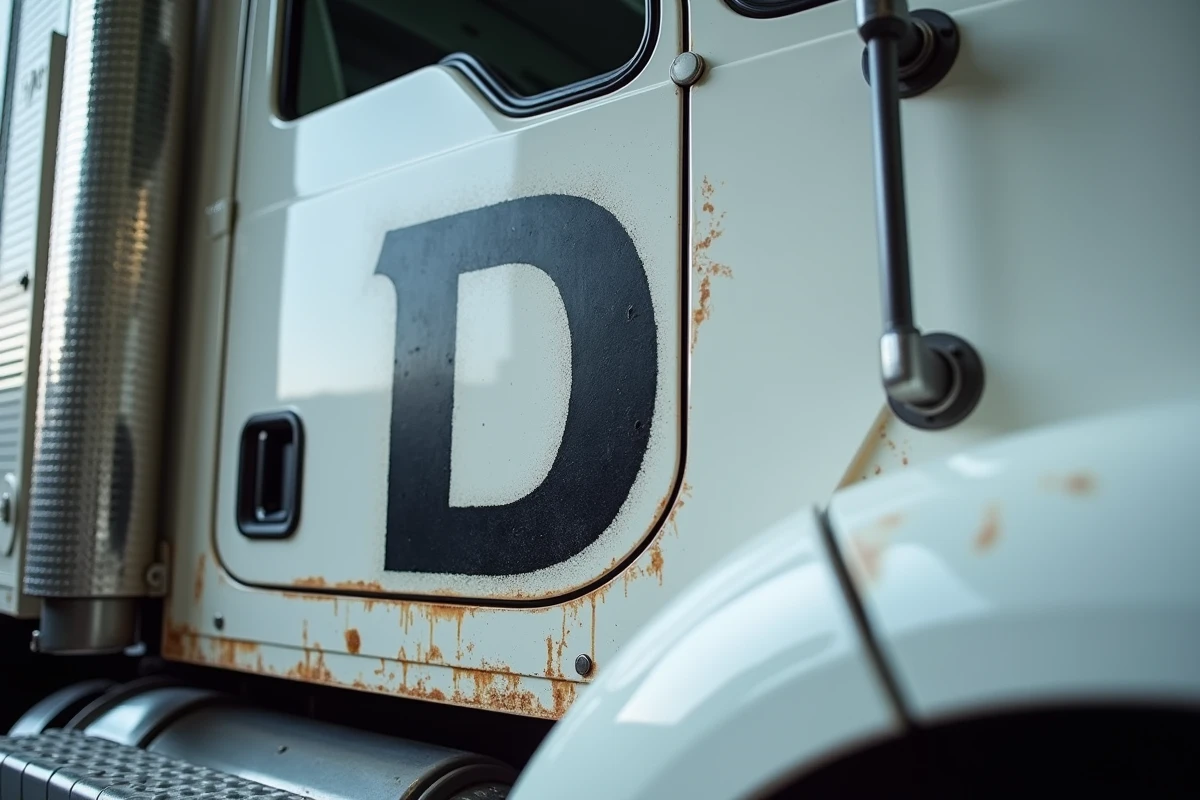
Have you ever noticed a large white letter “D” on a black background, fixed to the front or back of a truck or agricultural vehicle? This square sign is not trivial. It signals to other road users that the vehicle carrying it exceeds a certain width, which alters overtaking distances and the precautions to take while driving.
Wide vehicles and the D sign: a size constraint above all
Before discussing regulations, let’s address the concrete issue. A standard truck adheres to a maximum width of 2.50 meters. Some vehicles exceed this limit: self-propelled agricultural machines, towed public works equipment, exceptional convoys.
When such a vehicle travels on a narrow departmental road, oncoming motorists must anticipate an unusual size. The “D” sign serves exactly this purpose: it warns that the vehicle exceeds 2.50 m in width.
This marking is therefore not related to the type of goods transported, the weight of the vehicle, or the driver’s certification. It concerns only one physical data: the overall width. To delve deeper into the meaning of the letter D on trucks, one must refer to the texts governing road traffic.

Regulations for the D sign: what the text says
The most explicit legal framework is found in the decree setting the rules for road traffic. Article 205 of this decree specifies the following obligations.
- When the width of a self-propelled agricultural machine, a towed implement, or public works equipment exceeds 2.50 m, the towing vehicle must display at the front, at its upper part, a square sign illuminated from dusk, visible from 150 meters in clear weather.
- This sign displays a white letter D on a black background, with a height equal to or greater than 0.20 meters.
- If the front sign is not visible from the rear of the assembly, the last towed vehicle must also display a reflective device reproducing the same letter D in the same dimensions.
The text provides an exception: vehicles equipped with special lights reserved for slow-moving or bulky vehicles are not required to display this sign. In this case, the beacons or flashing lights already serve the alert function.
Why night changes everything
The D sign must be illuminated from dusk. The reason is simple: a wide vehicle traveling without sufficient side lighting becomes an almost invisible obstacle on an unlit road. An unlit D sign at night constitutes an offense, as it no longer fulfills its primary signaling function.
The required visibility distance (150 meters in clear weather, without glare) corresponds to the necessary distance for a driver traveling at normal speed to adjust their trajectory or brake.
Letter D and other markings on trucks: do not confuse
On the road, heavy trucks carry numerous inscriptions. It is easy to confuse the D sign with other signage. You may have noticed the round disks displaying 60, 80, or 90 at the back of trucks?
These stickers indicate the maximum speed allowed for the vehicle depending on the type of road. They have no relation to width. A truck can very well carry a 90 sticker without having a D sign, and vice versa.
Markings related to the transport of hazardous goods
Tank trucks and vehicles transporting hazardous materials display rectangular orange plates, accompanied by numerical codes (danger code and material code). These plates fall under ADR regulations, which govern the transport of hazardous goods by road. Again, there is no link with the D sign: ADR concerns the nature of the load, not the size of the vehicle.
Another source of confusion: transport documents such as the bill of lading or CMR. These paper documents accompany the goods and allow for inspections. The term “letter” in “bill of lading” has nothing to do with the letter D physically affixed to the vehicle.

Why the D sign matters for road safety
A vehicle wider than 2.50 m traveling on a departmental road occupies a significant portion of the roadway. On a two-way road without a hard shoulder, overtaking becomes a risky maneuver.
The D sign gives the following driver time to abandon a poorly initiated overtaking. Without this signal, the motorist discovers the actual size of the vehicle too late, sometimes just as they are already moving over.
This preventive function explains why the text imposes a minimum size of 20 centimeters for the letter and a visibility of 150 meters. A simple discreet sticker would not suffice.
Practical case: the combine harvester on the road
Combine harvesters commonly exceed 3 meters in width, sometimes more with the uncollapsed cutting bars. During harvest season, these machines travel on narrow roads, often at dusk. The D sign, combined with special lights, then serves as the first line of protection for users who encounter or follow the machine.
Road transport professionals and agricultural operators check this sign during each public road circulation. A roadside inspection can penalize the absence of the sign or a lighting defect, which engages the responsibility of the driver and the vehicle owner.
The D sign remains a simple, low-cost device, but directly linked to the prevention of accidents involving oversized vehicles. Its presence on a truck or machine signifies one thing: the vehicle is wider than the norm, and every road user must adjust their behavior accordingly.